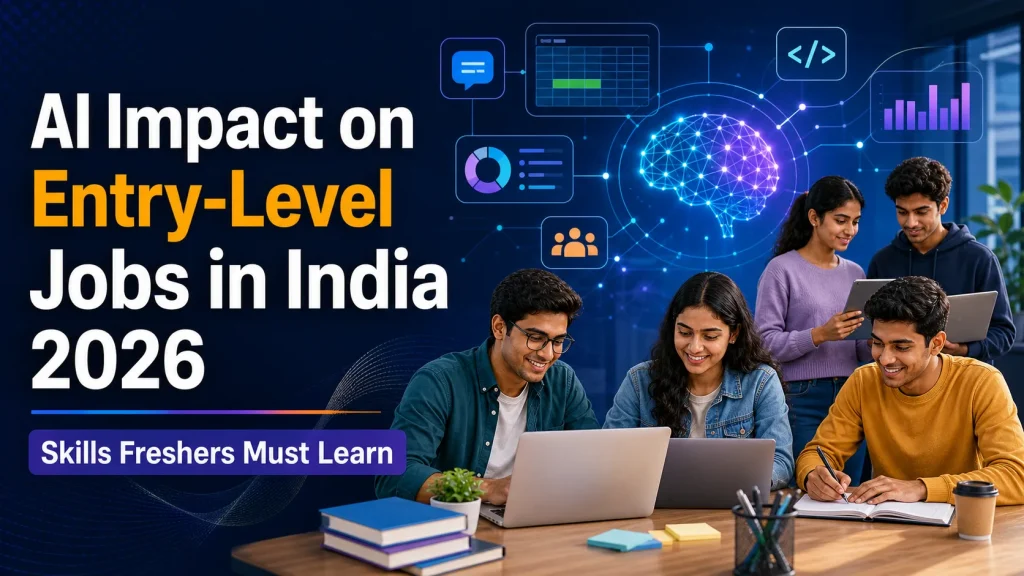
Artificial intelligence is changing how Indian freshers enter the workforce, but the evidence does not support a simple “AI will take all entry-level jobs” conclusion. The bigger change in 2026 is at the task level: software can now draft routine emails, summarise documents, produce first-pass code, answer common customer questions and screen large volumes of information. Employers still need people, but they increasingly expect new hires to check AI output, solve less-structured problems and apply tools within a business domain.
The opportunity remains meaningful. TeamLease EdTech’s Career Outlook Report for January-June 2026 found that 73% of surveyed employers intended to hire freshers, up from 70% in the previous half-year. Meanwhile, the India Skills Report 2026 placed national employability at 56.35%, compared with 54.81% in 2025. These figures suggest that the entry gate is not closed; it is becoming more skills-based and proof-of-work driven.
What AI Is Actually Doing to Entry-Level Work
AI exposure is not the same as job elimination. The International Labour Organization’s 2025 global index found that one in four workers is in an occupation with some generative AI exposure, with clerical work the most exposed. However, it concluded that job transformation is generally more likely than full replacement because most occupations combine automatable tasks with work requiring human judgement, accountability or interaction.
Want Instant Job Updates? 🚀
Join aspirants getting the latest sarkari naukri alerts on our official channels.
A World Economic Forum briefing on early careers reached a similarly balanced view. Entry-level workers were more likely to report curiosity and excitement about AI than worry, although nearly one-third remained anxious. For freshers, the useful question is therefore not “Will my profession vanish?” but “Which parts of this role can AI perform, and what higher-value contribution can I add?”
Entry-Level Roles Most Likely to Change
| Role area | Tasks increasingly assisted by AI | Skills that protect and improve employability |
|---|---|---|
| Administration and data entry | Form processing, scheduling, transcription and standard reports | Excel, data validation, workflow automation and process improvement |
| Customer support | Frequently asked questions, ticket classification and response drafts | Escalation handling, product knowledge, empathy and CRM analytics |
| Content and digital marketing | First drafts, captions, keyword ideas and basic image variations | Audience research, editing, analytics, brand judgement and campaign testing |
| Junior software and testing | Boilerplate code, documentation, test generation and debugging suggestions | Programming fundamentals, system thinking, security and code review |
| Finance and operations | Invoice extraction, reconciliation support and routine variance summaries | Financial analysis, controls, exception handling and domain regulations |
| Recruitment coordination | Resume sorting, interview scheduling and standard candidate communication | Structured interviewing, bias awareness, workforce analytics and candidate experience |
These roles are not necessarily disappearing. Their routine layer is becoming faster and cheaper, which may reduce demand for work that consists only of repetitive execution. Freshers who can supervise automated workflows, investigate exceptions and communicate decisions become more valuable.
Roles and Career Paths Likely to Grow
India’s demand is expanding beyond pure AI research. The foundit 2025 AI hiring analysis counted 2.90 lakh active AI job postings and estimated that demand could reach about 3.82 lakh roles in 2026. This is a job-platform projection, not a guaranteed outcome, but its skill data is useful: Python appeared in nearly 75% of AI roles, while SQL and data-engineering skills appeared in more than half. It also recorded growth in generative AI, MLOps and AI engineering.
- Data and business intelligence analyst: Cleans data, builds dashboards and translates findings into business actions.
- AI-enabled software developer: Uses coding assistants while understanding APIs, databases, testing, security and maintainable design.
- Cybersecurity analyst: Monitors threats, investigates alerts and protects AI-connected systems and data.
- Cloud, DevOps or MLOps associate: Helps deploy, monitor and improve applications or models in production.
- Marketing automation and CRM analyst: Combines customer data, experimentation, content judgement and automation tools.
- AI quality, safety and governance associate: Tests outputs, documents risks, checks bias and supports compliance and human oversight.
- Domain-plus-AI specialist: Applies AI in banking, healthcare, manufacturing, logistics, retail, education or climate-related work.
The World Economic Forum’s India analysis identifies big data, AI and machine learning, and security management among the country’s fastest-growing roles. It also says 63 out of every 100 Indian workers may require training by 2030. That makes continuous learning a normal career requirement rather than a one-time response to AI.
Skills Freshers Must Learn in 2026
1. AI literacy, not just prompting
Learn what generative AI can and cannot do. Practise writing clear instructions, supplying context, comparing outputs and checking claims. Understand hallucinations, model limitations, retrieval, basic automation and when a human must make the final decision.
2. Data skills
For most office and technology careers, useful foundations include spreadsheets, SQL, data cleaning, charts and basic statistics. You do not need to become a data scientist, but you should be able to question a dataset and explain what the numbers do not prove.
3. One strong domain
AI skills become more employable when paired with knowledge of customers, finance, supply chains, healthcare processes, manufacturing, HR or another field. Domain understanding helps you notice errors that a general-purpose tool may miss.
4. Human problem-solving
TeamLease’s 2026 survey lists communication, learning agility, problem framing, ethical judgement and digital fluency among in-demand fresher skills. Employers want candidates who can define the real problem, ask useful questions, collaborate and explain a decision clearly.
5. Proof of work
A certificate can support a profile, but a small portfolio demonstrates ability. Build two or three projects with a short problem statement, your method, the tools used, measurable results, limitations and what you would improve. Never present unreviewed AI output as your own expertise.
A Practical 90-Day Skill Plan
- Days 1-30: Build foundations. Choose one target role. Study its job descriptions, learn responsible use of one AI assistant, strengthen spreadsheets or SQL, and complete a small domain exercise each week. Keep notes on where the tool was wrong or incomplete.
- Days 31-60: Create two projects. Examples include a sales dashboard, customer-ticket classifier, secure FAQ assistant, marketing experiment or automated reporting workflow. Use realistic public or synthetic data, document your checks and publish a concise case study.
- Days 61-90: Become interview-ready. Improve your resume with project outcomes, practise explaining your work without jargon, solve role-specific assessments and apply consistently. Ask alumni or professionals for feedback, and tailor each application to the employer’s actual needs.
A good weekly split is 40% fundamentals, 30% project building, 20% job search and networking, and 10% reflection. Avoid spending the entire 90 days collecting unrelated certificates.
Responsible AI Skills Are Career Skills
Responsible use is no longer optional. India’s AI Governance Guidelines, released in November 2025, emphasise safe, inclusive and human-centred adoption. A fresher can put these principles into practice by following simple workplace habits:
- Do not paste confidential company, customer or personal data into an unapproved AI tool.
- Verify calculations, citations, legal claims, code and factual statements before use.
- Check whether outputs disadvantage people because of language, gender, location or other characteristics.
- Respect copyright, licences and company policies when generating text, images or code.
- Disclose meaningful AI assistance when required and keep a record of important prompts, sources and human approvals.
- Escalate high-impact decisions involving hiring, credit, health, safety or eligibility to qualified humans.
Frequently Asked Questions
Will AI reduce fresher jobs in India?
It may reduce some repetitive tasks and change team sizes in selected functions, but current Indian hiring reports still show substantial fresher demand. The likely outcome varies by role, industry and employer adoption. Candidates should prepare for redesigned jobs rather than assume universal job loss.
Do all freshers need to learn coding?
No. Coding is valuable for software, data and automation careers, but non-technical candidates can build strong profiles through data literacy, AI-assisted research, CRM tools, workflow design, communication and domain expertise.
Is prompt engineering a safe standalone career choice?
Prompting is useful, but it is stronger as part of a wider role. Combine it with software development, analytics, marketing, design, operations, research or governance so your value does not depend on one tool or interface.
Which skill should a fresher learn first?
Start with the skill most common in your target job descriptions. For many business roles that may be spreadsheets and communication; for data roles, SQL; for development, programming and version control. Add AI tools after building the underlying fundamentals.
How can a non-engineering graduate benefit from AI?
Use AI to improve research, analysis, customer service, marketing, HR, finance or operations while developing judgement in that domain. Employers increasingly need people who can connect technology with real business and social problems.
The Bottom Line
AI is raising the starting standard for many entry-level jobs in India, not eliminating the need for fresh talent. The strongest fresher profile in 2026 combines digital and AI fluency, dependable fundamentals, domain knowledge, communication, ethical judgement and visible project evidence. Learn to work with AI, but also learn when to question it. That combination is more durable than chasing every new tool.