Last reviewed: 27 April 2026
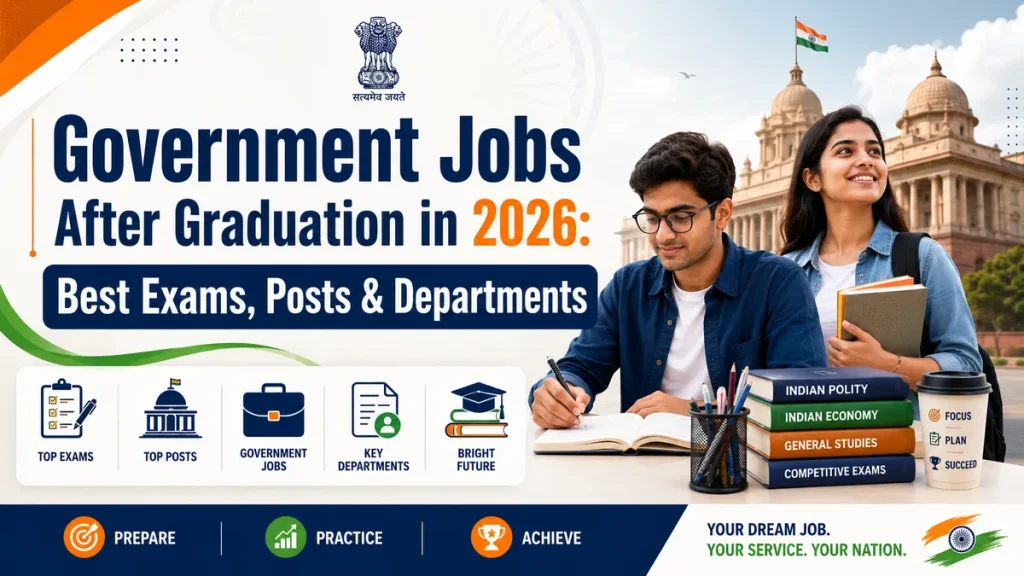
Graduation opens the door to many government job opportunities in India. Candidates with a bachelor’s degree can apply for several Sarkari Naukri options across SSC, UPSC, State PSC, banks, railways, police, PSUs, courts, universities, public sector organizations and state departments. But the best option depends on your degree, age, preparation level, preferred department, posting location and long-term career goal.
This guide explains the best government jobs after graduation in 2026, which exams graduates can target, how BA, BCom, BSc and BTech candidates can choose suitable options, what eligibility details to check, and how to avoid wasting time on vacancies that do not match your profile.
Want Instant Job Updates? 🚀
Join aspirants getting the latest sarkari naukri alerts on our official channels.
Looking for active graduate-level openings? Visit the Infocruit Latest Government Jobs section and search by qualification, department, degree or post name.
Quick Summary
- Graduates can target SSC, UPSC, State PSC, bank, railway, police SI, PSU, court, university and department-level posts.
- Some posts accept any degree, while others require a specific subject, professional degree, computer skill, technical branch or experience.
- BA, BCom, BSc and BTech graduates should choose exams based on strengths, not only popularity.
- A government exam is not the same as a job offer; most posts require exam, interview, skill test, PET/PST, DV or medical stages.
- Always check age limit, qualification, experience, salary, posting rules, bond/service condition and official notification before applying.
- Use Infocruit for quick job discovery and verify final details from the official recruitment notice.
Can Graduates Apply for Government Jobs in 2026?
Yes, graduates can apply for many government jobs in 2026. In fact, several popular competitive exams require graduation as the minimum educational qualification. These jobs may include officer-level, assistant-level, clerical, inspector, executive, trainee, technical, administrative and department-specific posts.
Common graduate-level opportunities include SSC CGL-type posts, bank PO and clerk roles, UPSC civil services, State PSC posts, railway graduate posts, police sub inspector, PSU trainee roles, court staff, university non-teaching posts and government department assistants.
Government Job vs Government Exam: What Graduates Should Understand
Many candidates search for “government jobs after graduation,” but in most cases, the first step is a recruitment exam or selection process. A notification does not mean direct joining. It means applications are open for a recruitment process.
| Term | Meaning | What You Should Check |
|---|---|---|
| Government Job | The final post or service after selection. | Salary, posting, department, work profile and service rules. |
| Government Exam | The selection test used to shortlist candidates. | Exam pattern, syllabus, stages, cut off and competition level. |
| Recruitment Notification | Official document announcing vacancies and rules. | Eligibility, dates, fee, vacancies, age limit and apply link. |
| Provisional Selection | Shortlisted status before final checks. | Document verification, medical, category proof and joining instructions. |
A BCom graduate preparing for bank exams and a BTech graduate targeting PSU posts should not follow the same preparation path. The smarter approach is to match your degree, strengths and time availability with the right recruitment cycle.
Best Government Job Options After Graduation
| Job Category | Common Exams / Posts | Best For |
|---|---|---|
| SSC Jobs | SSC CGL-type assistant, inspector, auditor, accountant and officer-level posts | Graduates comfortable with aptitude, reasoning, English and general awareness. |
| UPSC Jobs | Civil services, defence services and other UPSC graduate-level exams | Candidates ready for long-term preparation and national-level competition. |
| State PSC Jobs | Deputy collector-type posts, officer posts, assistant posts, state services | Candidates preferring state-level administrative careers. |
| Bank Jobs | PO, clerk, apprentice, assistant or specialist roles where eligible | Graduates interested in finance, customer service and banking operations. |
| Railway Jobs | Graduate-level NTPC-type posts, station, clerical, commercial and administrative roles | Candidates looking for large-scale all-India railway opportunities. |
| Police Jobs | Sub Inspector, assistant sub inspector, investigation and enforcement roles | Physically fit graduates interested in uniformed services. |
| PSU Jobs | Management trainee, engineer trainee, officer, executive and apprentice roles | BTech, MBA, CA, CMA, science, commerce and technical graduates depending on post. |
| Court / University Jobs | Clerk, assistant, stenographer, translator, non-teaching staff | Graduates with language, typing, office or administrative skills. |
Government Jobs After BA, BCom, BSc and BTech
Graduate-level eligibility changes by degree and department. Some jobs accept any bachelor’s degree, while others require a specific discipline. Candidates should use their degree strengths while choosing exams.
| Degree | Suitable Government Job Options | Important Checks |
|---|---|---|
| BA | SSC, UPSC, State PSC, police SI, court staff, teaching support, social welfare and administrative posts | Language, general studies, writing ability, state-specific eligibility and physical tests for police posts. |
| BCom | Bank jobs, SSC accountant/auditor-type posts, tax assistant, accounts assistant, finance department jobs | Accounts knowledge, computer skill, banking aptitude and post-specific qualification rules. |
| BSc | SSC, UPSC, State PSC, lab assistant, scientific assistant, forest, health, agriculture or technical support posts | Subject-specific eligibility, lab/technical requirements and department rules. |
| BTech / BE | PSU, engineer trainee, junior engineer where eligible, technical officer, scientist assistant, railway technical posts | Engineering branch, GATE requirement if any, technical exam pattern and experience rules. |
| Any Degree | SSC CGL-type posts, bank PO/clerk, police SI, railway graduate posts, state assistant posts | Age limit, exam pattern, selection stages and category relaxation. |
Which Graduate Government Job Is Best for Which Candidate?
A graduate candidate should not choose an exam only because it is popular. A bank exam, a police SI exam, a State PSC exam and a PSU technical post need different preparation styles.
| Candidate Type | Better Job Options | Why |
|---|---|---|
| Good at aptitude and English | SSC, bank, railway graduate exams | These exams often test reasoning, quantitative aptitude, English and awareness. |
| Strong in general studies | UPSC, State PSC, administrative posts | These exams reward broad preparation and current affairs understanding. |
| Commerce background | Bank, accounts, audit, tax assistant, finance department posts | Commerce knowledge can help in finance-related roles. |
| Physically fit | Police SI, defence, enforcement and forest officer-type posts | Physical and medical standards may be key selection stages. |
| Technical degree holder | PSU, technical officer, engineer trainee, scientific assistant roles | Technical posts may value engineering or science specialization. |
| Wants home-state posting | State PSC, state departments, state police, local bodies | State recruitment may be better for local language and location preference. |
| Wants office-based work | Bank, SSC assistant, court staff, university non-teaching, accounts posts | Better fit for candidates who prefer desk-based roles over field roles. |
Government Jobs After Graduation for Female Candidates
Female candidates can apply for many graduate-level government jobs, depending on eligibility, age limit, category rules, physical standards and posting preferences. The best choice should be based on comfort with the selection process and work profile, not only the post title.
| Preference | Suitable Options | What to Check |
|---|---|---|
| Office-based roles | SSC assistant posts, bank jobs, court staff, university non-teaching, accounts roles | Typing, computer skill, transfers, working hours and posting location. |
| Administrative roles | UPSC, State PSC, department officer posts | Exam stages, interview, service allocation and posting rules. |
| Uniformed roles | Police SI, defence entries, forest/enforcement roles where eligible | Height, running, medical standards, physical tests and gender-wise rules. |
| State-level preference | State PSC, state departments, state police, local bodies | Domicile, language, reservation and local posting rules. |
SSC Jobs After Graduation
SSC graduate-level exams are popular because they offer multiple central government posts through a common selection process. Depending on the exam and notification, graduates may apply for assistant, inspector, auditor, accountant, tax assistant, statistical and other department-level posts.
Candidates should check exact qualification, age limit, tier-wise exam pattern, skill test requirement, physical standards for specific posts and document verification rules before applying.
Bank Jobs After Graduation
Graduates can target banking roles such as probationary officer, clerk, apprentice, assistant or specialist roles where the official notification allows. Banking exams usually test reasoning, quantitative aptitude, English, general awareness, computer knowledge and banking awareness.
Bank jobs are suitable for candidates who are comfortable with speed-based exams, customer-facing roles, transfers and performance-based work culture. Always check whether the post requires only graduation or a specific degree/professional qualification.
UPSC and State PSC Jobs After Graduation
UPSC and State PSC exams are strong options for graduates who want administrative, civil service, police, revenue, foreign service, forest, accounts or other officer-level roles. These exams usually need serious preparation and a long-term study plan.
Candidates should check age limit, attempt limit, optional subject rules, state language requirement, physical standards for specific services and interview/personality test process.
Railway Jobs After Graduation
Railways may release graduate-level posts in clerical, commercial, station, administrative and technical categories depending on recruitment cycle and official notice. These jobs can attract large competition because of all-India reach and broad eligibility.
Before applying, check post preference, medical standard, typing requirement, exam stage, normalization rules and zone-wise posting conditions.
Police and Defence Jobs After Graduation
Graduates who are physically fit can consider police sub inspector, assistant sub inspector, enforcement, investigation, defence graduate entry and similar uniformed roles. These jobs require more than written exam preparation.
Check height, chest, running, endurance test, medical standards, age limit, gender-wise rules and document verification requirements before applying.
PSU Jobs After Graduation
PSU jobs can be a strong option for graduates, especially candidates with BTech, MBA, CA, CMA, law, science, commerce or other specialized degrees. Posts may include management trainee, engineer trainee, officer, executive, assistant and apprentice roles depending on the organization.
Some PSU jobs may require GATE score, professional qualification, experience or branch-specific eligibility. Do not assume every graduate can apply for every PSU post.
Fresh Graduates vs Experienced Graduates
| Candidate Stage | Better Focus | What to Check |
|---|---|---|
| Fresh graduate | SSC, bank, railway, State PSC, police SI, apprentice, trainee posts | Whether experience is required or not. |
| 1–3 years experience | Assistant, executive, project, contractual, PSU and specialist support roles | Whether private experience is accepted. |
| Technical experience | PSU, engineer, technical officer, IT, research or project posts | Required years, domain and certificate proof. |
| Professional qualification | Finance, law, HR, IT, management, accounts and specialist posts | Degree, certification, membership and experience rules. |
Government Jobs vs Private Jobs After Graduation
Graduates often compare government jobs and private jobs. The better choice depends on your risk appetite, salary expectations, growth speed, location preference and preparation timeline.
| Factor | Government Jobs | Private Jobs |
|---|---|---|
| Selection | Usually exam-based, interview-based or rule-based recruitment. | Usually resume, skills, interview and company hiring process. |
| Preparation Time | May require months or years for competitive exams. | Can be faster if skills and openings match. |
| Stability | Generally valued for job security and structured benefits. | Depends on company, role, industry and performance. |
| Growth | Promotion rules may be structured but slower. | Growth can be faster but varies widely. |
| Best For | Candidates who can commit to exam preparation and official processes. | Candidates who want quicker entry, skill-based growth or flexible industries. |
A practical path is to apply for suitable government jobs while also building employable skills. This helps fresh graduates avoid depending on only one route.
Eligibility Details to Check Before Applying
| Eligibility Point | Why It Matters |
|---|---|
| Degree Requirement | Some jobs accept any degree, while others need specific subjects or branches. |
| Age Limit | Age cut-off date and relaxation rules differ by recruitment. |
| Experience | Freshers and experienced posts have different eligibility conditions. |
| Selection Process | May include prelims, mains, interview, skill test, PET/PST, DV or medical. |
| Application Fee | Fee may differ by category, gender or exemption rules. |
| Salary / Pay Level | Helps compare long-term career value. |
| Job Location | Some posts are all-India, state-specific, transferable or project-based. |
| Bond / Service Condition | Some PSUs and training posts may include bond or service commitment. |
| Official Notification | Final source for eligibility, dates, fee, vacancies and selection rules. |
Verify the Official Notification Before Applying
Before applying for any graduate-level government job, verify the official notification, official apply link, fee, last date and corrigendum notices. Do not depend only on screenshots, forwarded PDFs or social media posts.
- Download the official notification PDF.
- Match the advertisement number and post name.
- Check whether your degree is accepted.
- Confirm age limit, fee and last date.
- Check for corrigendum, extension or revised schedule.
- Use only the official apply link.
- Save the application form and payment receipt.
How Infocruit Helps Graduates Find Government Jobs
Infocruit helps candidates discover active graduate-level vacancies and understand important details like qualification, age limit, fee, salary, selection process, official notification and apply link. This saves time because candidates can quickly skip posts that require different education, experience or technical eligibility.
- Open Infocruit Latest Government Jobs.
- Search terms like “graduate”, “degree”, “BCom”, “BSc”, “BTech”, “SSC”, “bank” or “State PSC”.
- Open the job update that matches your degree and interest.
- Check the official notification, age limit, salary and selection process.
- Verify whether experience, skill test, physical test or specific subject is required.
- Apply only through the official link before the last date.
You can also check related sections for admit cards, results, syllabus updates, answer keys and private jobs.
Common Mistakes Graduates Make While Applying
- Applying only because the post says “any graduate” without reading full eligibility.
- Ignoring age cut-off date and category relaxation rules.
- Missing subject-specific or branch-specific qualification.
- Not checking experience requirement for officer or specialist posts.
- Ignoring physical standards for police, defence or forest roles.
- Assuming every PSU post is open to all graduates.
- Choosing only popular exams instead of matching strengths and work profile.
- Waiting until the last date to apply.
- Using unofficial apply links instead of the official portal.
- Not saving application form, fee receipt and registration number.
Final Checklist Before Applying
- ✅ I checked whether my degree is accepted.
- ✅ I checked age limit and relaxation rules.
- ✅ I checked whether experience is required.
- ✅ I checked exam pattern and selection process.
- ✅ I reviewed salary, posting and service conditions.
- ✅ I checked bond or service commitment if mentioned.
- ✅ I verified fee and official apply link.
- ✅ I checked for corrigendum or extension notice.
- ✅ I read the official notification carefully.
- ✅ I saved the final application form and receipt.
Conclusion
Government jobs after graduation in 2026 can offer strong career options across SSC, UPSC, State PSC, banks, railways, police, PSUs, courts and state departments. The best choice depends on your degree, strengths, preparation style and preferred work profile. Instead of applying randomly, shortlist jobs based on eligibility, selection process, salary, posting, service rules and long-term growth.
To find active graduate-level vacancies, visit the Infocruit Latest Government Jobs section and verify final details from the official notification before applying.
Frequently Asked Questions
1. Which government jobs are available after graduation in 2026?
Graduates can apply for SSC, UPSC, State PSC, bank, railway, police SI, PSU, court, university and department-level government jobs depending on eligibility.
2. Can any graduate apply for government jobs?
Many posts accept any bachelor’s degree, but some require a specific subject, branch, professional qualification, computer skill, physical standard or experience. Always check the official notification.
3. Which government exams are best after graduation?
Popular options include SSC graduate-level exams, UPSC, State PSC, bank PO/clerk exams, railway graduate posts, police SI exams and PSU recruitments depending on the candidate’s goal.
4. Are government jobs available for fresh graduates?
Yes, many SSC, bank, railway, State PSC, police and trainee posts are open to fresh graduates if they meet age and qualification rules.
5. Are government jobs available after graduation for female candidates?
Yes. Female candidates can apply for SSC, bank, State PSC, court, university, railway, police, defence and department-level posts where they meet the eligibility, age limit, physical standard and selection rules.
6. Are PSU jobs available after graduation?
Yes, but PSU eligibility varies. Some posts require BTech, MBA, CA, CMA, law, science, commerce or other specific qualifications, and some may require GATE score or experience.
7. Should graduates choose government jobs or private jobs?
Government jobs are better for candidates who can commit to competitive exams and value stability. Private jobs may suit candidates who want quicker entry, skill-based growth or industry flexibility. Many graduates prepare for both routes early.
8. How can I find latest graduate government jobs?
You can search by qualification, degree or department on Infocruit’s latest government jobs section and verify final details from the official notification before applying.