For decades, the standard path to a successful career followed a predictable template: attend a reputable university, earn a four-year degree, and use that credential as an entry pass to the corporate world. However, as we move through 2026, that traditional path is undergoing a fundamental transformation.
Today’s employers are shifting away from rigid academic pedigree in favor of skills-based hiring. Rather than screening candidates based on the name of their university or the exact title of their major, companies are asking a much more practical question: “What can you actually do?”
This change represents a massive opportunity for job seekers. If you lack a formal degree in your field, or if you are looking to transition to a completely new industry, the skills-based hiring model opens doors that were previously locked. But landing these roles requires a shift in how you build, package, and present your capabilities.
Want Instant Job Updates? 🚀
Join aspirants getting the latest sarkari naukri alerts on our official channels.
Why Employers Are Shifting to Skills-First Hiring
The rise of skills-based hiring is not a temporary trend; it is a structural response to a fast-moving economic landscape. Several key factors are driving this change in 2026:
1. Technology Moves Faster Than Curriculums
The rapid expansion of artificial intelligence, machine learning, and automation means that technical workflows are changing every few months. Traditional university programs, which often take years to update their syllabi, struggle to keep pace. By the time a student graduates, the tools they learned in their sophomore year may already be obsolete. Employers have realized that certifications, bootcamps, and self-directed projects are often better indicators of up-to-date technical fluency.
2. AI as a Career Co-Pilot
AI is no longer just a novelty; it is actively integrated into daily business operations. Research from major industry reports, including PwC’s recent work on labor markets, shows that AI is augmenting jobs rather than replacing them entirely. Because AI handles routine, repetitive data processing and drafting tasks, the human role has shifted toward strategic oversight, validation, and complex problem-solving. This requires a different set of specialized skills that a traditional classroom lecture cannot always teach.
3. The Need for “Plug-and-Play” Talent
In a competitive economic environment, companies want professionals who can contribute immediately. A degree proves that someone can pass exams and complete coursework over four years, but it does not guarantee they can manage a modern digital marketing campaign, debug a production server, or write clean code. Real-world projects and proof of execution show immediate utility.
The High-Demand Skill Sets for 2026
To thrive in this new hiring environment, you need to understand which skills employers are actively seeking. In 2026, the most successful candidates possess a mix of technical literacy, strategic capability, and soft skills.
Technical & Digital Capabilities
- AI Literacy & Workflow Automation: You do not necessarily need to be a machine learning researcher, but you must know how to use AI tools as a co-pilot. Understanding prompt engineering, using AI to analyze data, and setting up automated workflows (using tools like Zapier or Make) are highly valued skills across marketing, sales, and operations.
- Data Translation: Data is abundant, but professionals who can read data, interpret trends, and translate them into actionable business strategies are rare. Data literacy is no longer just for software engineers; it is essential for managers, marketers, and HR professionals.
- Cybersecurity Basics: As businesses become fully digital, security is everyone’s responsibility. Knowing how to handle data securely and understanding basic digital hygiene makes you a safer hire.
The “Human” Premium (Soft Skills)
As technical tasks are increasingly automated, the value of uniquely human traits has skyrocketed. Employers refer to this as the “human premium”:
- Adaptability & Continuous Learning: The ability to learn, unlearn, and relearn is the single most critical asset in 2026. Employers look for a track record of self-directed upskilling.
- Strategic Judgment: AI can generate options, but humans must make the final decisions. Strategic thinking, risk assessment, and ethical judgment are highly prized.
- Complex Communication: Being able to collaborate across departments, explain technical concepts to non-technical stakeholders, and lead cross-functional teams is incredibly difficult to automate.
How to Build a “Skills-First” Resume
If you do not have a formal degree to highlight at the top of your resume, your resume must lead with proof of capability. Here is how to restructure your resume to stand out to skills-focused recruiters:
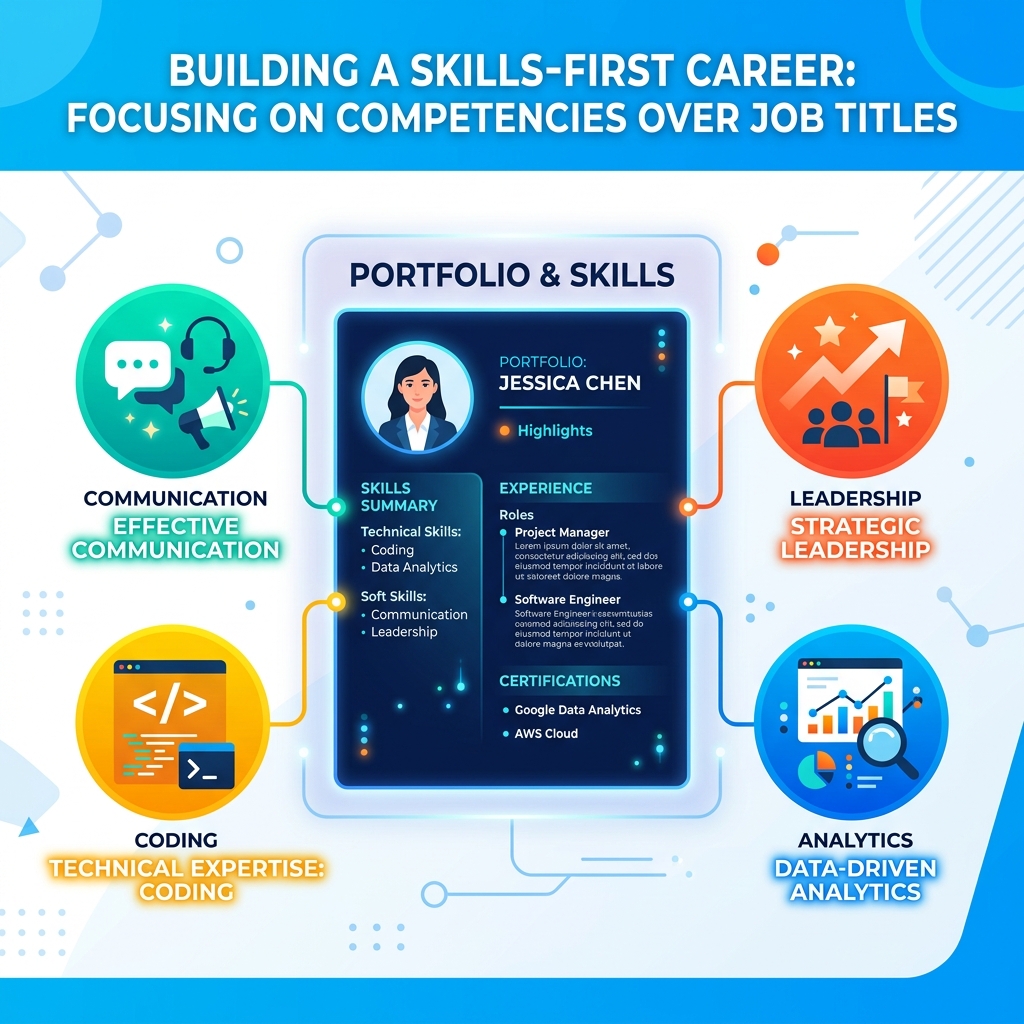
1. Lead with a “Skills & Core Competencies” Section
Instead of hiding your skills at the bottom of page two, place a clean, structured skills section right below your professional summary. Group your skills logically—for example, “Technical Proficiencies,” “Core Methodologies,” and “Tools & Software.” This ensures that both automated resume scanners and human recruiters immediately see your capabilities.
2. Focus on Outcomes, Not Duties
Do not list your previous job responsibilities as a simple list of chores. Instead, frame your experience around achievements and metrics.
- Weak: “Responsible for managing social media accounts.”
- Strong: “Managed corporate social media presence, using analytics to optimize posts and increase referral traffic by 34% over six months.”
3. Highlight Micro-Credentials and Certifications
If you have taken courses on platforms like Coursera, edX, or Udacity, or if you hold industry-recognized certifications (such as Google Analytics, Salesforce, AWS, or project management credentials), feature them prominently. These certifications prove to employers that you have actively invested in your own development and possess validated, modern skills.
4. Link to a Portfolio of Real Work
For many modern roles—including web development, copywriting, design, product management, and data analysis—a portfolio is far more valuable than a resume. Create a clean, personal website or a GitHub repository containing case studies of projects you have completed. Explain the problem you faced, the tools you used to solve it, and the final results.
Acing the Skills-Based Interview
The interview process for a skills-based role is often different from a traditional corporate interview. Employers want to see your skills in action. Be prepared for the following stages:
1. Practical Assessments and Case Studies
Many companies now use take-home assignments or live problem-solving sessions to evaluate candidates. Approach these tasks systematically. If you are given a case study, focus on explaining your methodology and reasoning. Employers care just as much about how you think as they do about the final answer.
2. Behavioral Questions (The STAR Method)
When asked about your experience, use the STAR method (Situation, Task, Action, Result) to structure your answers. This keeps your responses focused on actions and measurable outcomes:
- Situation: Briefly set the scene (e.g., “At my last job, we were losing 15% of our monthly leads due to a slow follow-up process”).
- Task: Explain what needed to be done (“I was tasked with finding a way to automate our lead response system”).
- Action: Detail the specific steps you took (“I implemented an automated email workflow and trained the sales team on using the new dashboard”).
- Result: Share the positive outcome (“This reduced lead response time from 12 hours to under 15 minutes, boosting conversions by 22%”).
3. Demonstrate Curiosity and Learnability
Since workflows change rapidly, show the interviewer that you are an active learner. Discuss recent topics you have researched, new tools you are testing, or courses you are currently taking. Showing that you have a proactive growth mindset makes you a highly attractive candidate for long-term growth.
Conclusion: Taking Control of Your Career Path
The shift toward skills-based hiring is a democratizing force in the modern job market. It levels the playing field, ensuring that talent, drive, and practical ability matter more than a piece of paper from a university.
By identifying the high-demand technical and human skills in your industry, dedicating time to self-directed learning, and building a portfolio that proves your capability, you can successfully land high-paying, fulfilling roles in 2026—regardless of your academic background. Focus on building real capabilities, and the market will respond.